Leaders from NVIDIA, Google and Meta discussed the infrastructure, institutions and application layer that will define India’s AI future at Masters’ Union’s The Next Tech 1.0 summit
Gurugram, (Haryana) [India] April 20, 2026: Masters’ Union, one of India’s leading B-schools, concluded Next Tech 1.0, its AI and technology summit, at DLF CyberPark, Gurugram today, bringing together founders, policymakers, technologists and operators to discuss how India should build in the age of AI. Conducted by Masters’ Union’s ‘School of AI’, the summit featured speakers including Vishal Dhupar, MD, Asia and South, NVIDIA; Nuseir Yassin, Founder and CEO, Nas.com ; and CP Gurnani, Co-founder, AIONOS and former CEO and MD, Tech Mahindra, among others.
‘India Has a Possibility to be Called the Global Intelligence of the World’ – NVIDIA’s Vishal Dhupar on the Rise of the “AI Factory” and 1.4 Billion New Creators – In his address at the summit, NVIDIA MD Vishal Dhupar said that we have officially moved beyond the era of data retrieval to a stage of “manufacturing intelligence,” asserting that in this new economy, “that factory is called AI”. He highlighted the staggering technical scale of this shift, revealing that a single modern AI rack now possesses a “bandwidth which is greater than the entire internet put together”. Predicting that India will pivot from a “back office” to a global intelligence hub, Dhupar argued that the removal of the coding barrier is the country’s ultimate advantage: “Imagine what 1.4 billion people can do because computers now speak in your language, in your dialect, and you don’t have to learn its language,” he added.


Cautioning startups focusing solely on the “icing” of AI applications, Dhupar described the AI economy as a “five-layer cake” where many are building on shaky foundations. He argued that many current applications are “brittle” because founders fail to understand the layers below—energy, chips, and infrastructure. “If you don’t go to the three layers below that, you won’t be able to solve this problem,” he added, noting that production-quality AI requires a deep mastery of the entire stack, not just the model layer.
Nas Daily said, “the Age of the 100,000-Person Company Is Ending” – Nas Daily founder Nuseir Yassin said AI will steadily erode the logic of large, bloated organisations and push the economy toward far smaller companies, where individuals operate more like owners than employees. Arguing that abundant intelligence will make routine execution vastly cheaper, he said the future will favour solopreneurs, compact teams and more distributed ownership structures over the traditional 100,000-employee corporation. He also suggested this shift will force a rethink of higher education, saying many traditional universities are no longer attracting the strongest talent or building for an AI-first world.
“One-Third of Gujarat is a Unit-Trader”: CP Gurnani Responds to AI’s Threat to Big IT – Responding to the premise that AI will radically shrink traditional IT firms, AIONOS co-founder and former CEO, Tech Mahindra, CP Gurnani argued that the shift toward the “solopreneur” is a return to deeply rooted economic models, noting that “one-third of Gujarat is a unit-trader”. He asserted that as AI agents handle the “grunt work,” the industry will see a “rise of entrepreneurship, which means a better networked entrepreneur”. Declaring that “the ‘fiction’ word has gone away” because “reality is changing faster than what you and I can even dream of,” Gurnani urged the tech community to stop making excuses and instead leverage India’s status as the world’s “data capital” to build indigenous, world-class platforms.
The conversations across the day focused on a common theme: that AI is no longer a future technology debate, but an operating reality that is already reshaping how companies are built, how talent is trained, and how India must think about its next wave of economic growth. The summit also featured sessions with Bikram Singh Bedi, former India MD, Google Cloud; Jeanie Fang, Director, Data & AI, Crunchbase; Joydeep Roy, Partner, Human Capital, PwC; Varun Das, Chief Product Officer and EVP, Airtel Digital; Ojasvi Bhatia, Lead, AI Partnerships, India, Meta; leaders from IBM, Narayana Health, Indeed, Cisco; and a live AI filmmaking hackathon where teams used AI tools to conceive, generate and edit short films in real time.
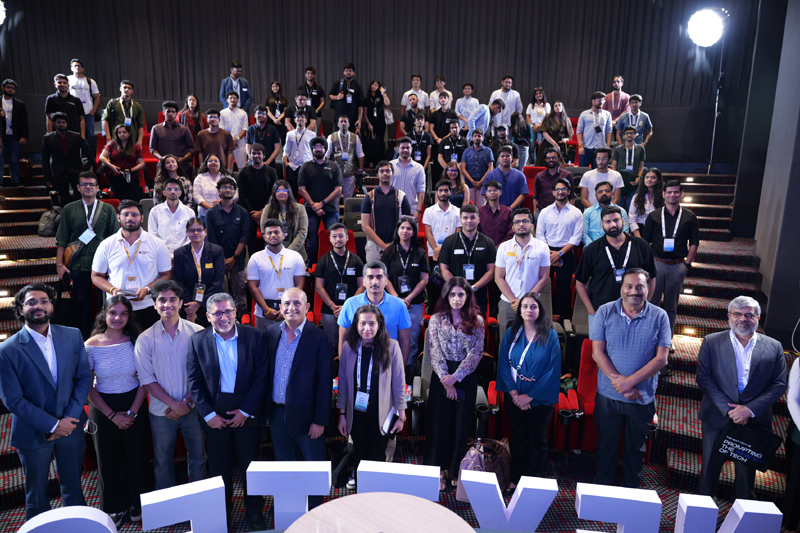
Held at Masters’ Union’s campus at DLF Cyber Park, Gurugram, the summit brought together over 500 attendees for a day of keynotes, hands-on labs, Shark Tank-style pitches and a live AI filmmaking hackathon. Designed as a builder-led extension of the summit, these formats aimed to move the conversation beyond theory, with participants pitching ideas, experimenting with AI tools and using them in real time to create short films on the floor.
Pratham Mittal, Founder, Masters’ Union, said, “AI is not just creating a new technology cycle; it is changing the structure of companies, the nature of work, and the skills that will matter in the years ahead. The aim with The Next Tech 1.0 was to bring builders, policymakers, operators and students into one room to think seriously about what India must build now if it wants to lead in the AI era. The next decade will belong to those who build on top of intelligence, not just talk about it.”
About Masters’ Union:
Masters’ Union is a practitioner led college in Gurugram that stands for experiential learning. It was founded in 2020 with the philosophy of hands-on learning, where students learn by doing. The leadership behind Masters’ Union consists of graduates from Stanford, Wharton, and IITs and IIMs. Unlike traditional colleges, the faculty at Masters’ Union comprises MDs, CXOs and AI Experts from companies such as Amazon, Apple, IBM, McKinsey, PwC, and KPMG. Additionally, the Institute also brings in faculty from the world’s top-ranked universities, such as Oxford & Harvard. Visit https://mastersunion.org/